
Choose sealer
Granite, quartzite, or stone floors, or marble you are happy to have polished every few years.
Expert Stone Repair • Las Vegas, NV
Three ways to protect marble countertops, and they protect against different things. Here's what each one actually does, from a Las Vegas restoration team that sees the results of all three every week.

Short answer
A penetrating sealer soaks into the pores and slows stains. It does nothing for etching, because etching is acid dissolving the surface itself.
A protective film or thick resin blocks acid completely, but it is a layer of plastic on top of your stone. Our etch-resistant coating sits between the two: it bonds into the surface, stays breathable, and makes the stone highly etch-resistant without the plastic look.
Side by side
| Feature | Our etch-resistant coating | Penetrating sealer | Film or thick resin |
|---|---|---|---|
| Stains | Resists them | Slows them | Blocks them |
| Etching | Highly resistant: time to wipe up spills | No protection | Blocks it while the layer is intact |
| Look and feel | Natural stone, matte or gloss | No change | Can look or feel like plastic |
| Breathable | Yes | Yes | Often no; can trap moisture |
| Upkeep | pH-neutral cleaner; spot-treat if needed | Reseal every 6 to 12 months on busy counters | Replace or recoat when damaged |
Sealer
On granite, quartzite, travertine floors, and showers, a good penetrating sealer is often all you need. It keeps oil and wine from soaking in and makes cleaning easier. It just can't stop acid from eating the surface of marble, limestone, or travertine counters.
Films and resins
Films, epoxies, and urethanes protect by covering the stone. That works, but porous stone can't release moisture vapor through a sealed layer, which can cloud it over time. Films have edges that can lift at sinks and seams on large islands, and a damaged sheet usually has to be replaced.
Las Vegas
Our water runs around 16 grains per gallon, so faucet areas build mineral rings. Dry air concentrates spills before you notice them. And many "all-purpose" cleaners are acidic. Marble in Las Vegas kitchens etches fast, which is why we restore so much of it.
Straight answer
Granite, quartzite, or stone floors, or marble you are happy to have polished every few years.
You want a complete acid barrier and don't mind a layer you can see and feel.
Marble or quartz you use daily, and you want it to still look and feel like stone.
Living with it
Want the full picture? See our etch-resistant coating page, or compare more options below.
Common questions
No. Sealer fills the pores to slow stains. Etching is acid dissolving the surface itself, and sealer does not stop it. That is why sealed marble still gets dull rings.
Start with a restored surface, then pick protection for how you use the kitchen. Sealer alone suits light use. For daily cooking with wine, citrus, and sauces, an etch-resistant coating does far more.
Usually not. Quartz is not porous, so sealer has little to soak into. If your quartz is ringing or staining, sealer will not fix it; repair and an etch-resistant coating will.
Text photos and rough measurements. We restore the stone first, then coat it, in one visit.
Serving Las Vegas, Henderson, and Summerlin.
Every job is backed by our one-year warranty.
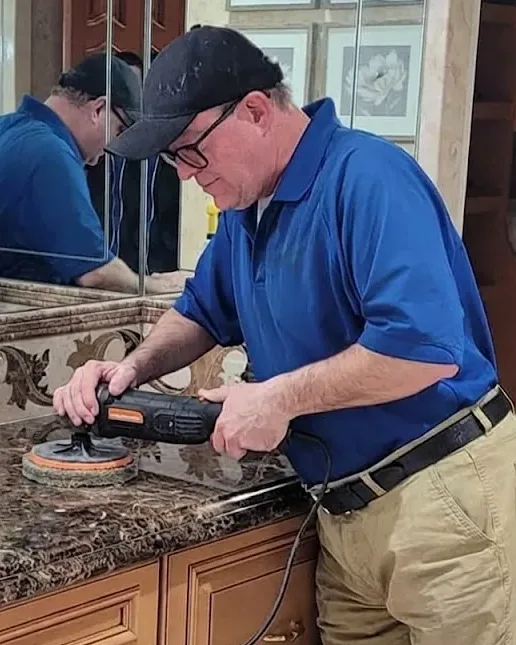
Owned by Robert Falzone, an IICRC-approved instructor who trains other stone restoration professionals. Robert and our lead technician, Josh, do the work themselves.