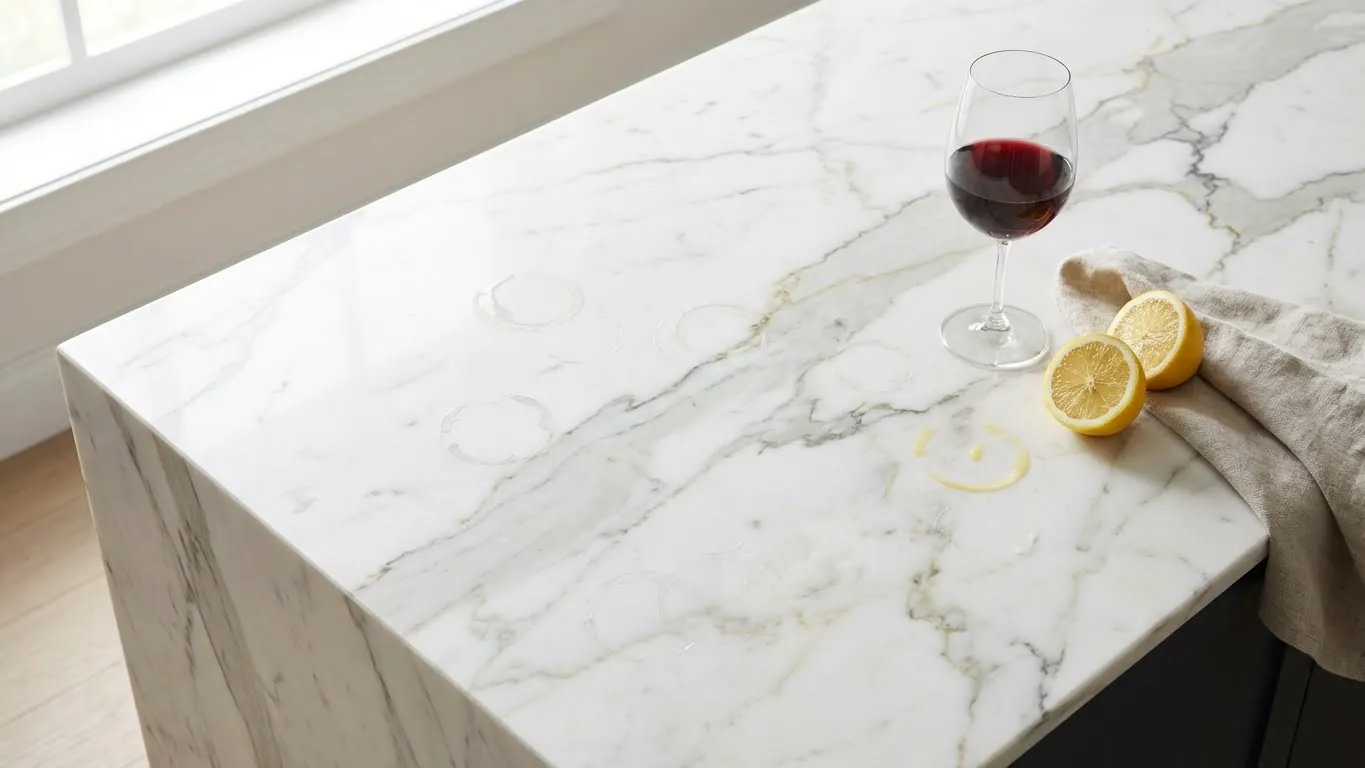
Marble is beautiful, but it is not maintenance-free. The best care routine starts with knowing three things: what the material actually is, what finish is on the surface, and whether the mark you see is residue, a stain, mineral scale, scratching, or etching.
That distinction matters in Las Vegas. The Southern Nevada Water Authority lists local water hardness at 280 parts per million, or 16 grains per gallon, and categorizes it as very hard. Mineral deposits can build up around faucets and shower lines. Desert grit can scratch floors. Acidic food, drinks, or cleaners can etch the calcium-based surface of true marble.
This guide explains a safe marble-care routine, common commercial marble names, honed versus polished finishes, and when cleaning is no longer the right answer. If your marble stays dull after safe cleaning, send photos for a marble restoration assessment in Las Vegas.
What marble is—and why acids matter
True marble is a metamorphic rock. It forms when limestone changes under heat and pressure, and its basic mineral is usually calcite. Calcite is calcium carbonate, which places marble in the calcareous stone family.
That classification matters because calcium carbonate reacts to acids. Lemon juice, vinegar, wine, tomato products, and some bathroom cleaners can leave a dull mark on marble. The mark is called etching. It is a change to the surface, not a layer of dirt sitting on top.
The Natural Stone Institute’s care guidance recommends mild, non-acidic cleaning for calcareous stone and warns that lemon, vinegar, and other acids may dull or etch it.
- Stain: discoloration absorbed into the stone or left by oil, coffee, cosmetics, or rust.
- Mineral scale: a raised or crusty deposit left behind as water evaporates.
- Residue: a film from too much cleaner, soap, or an incompatible product.
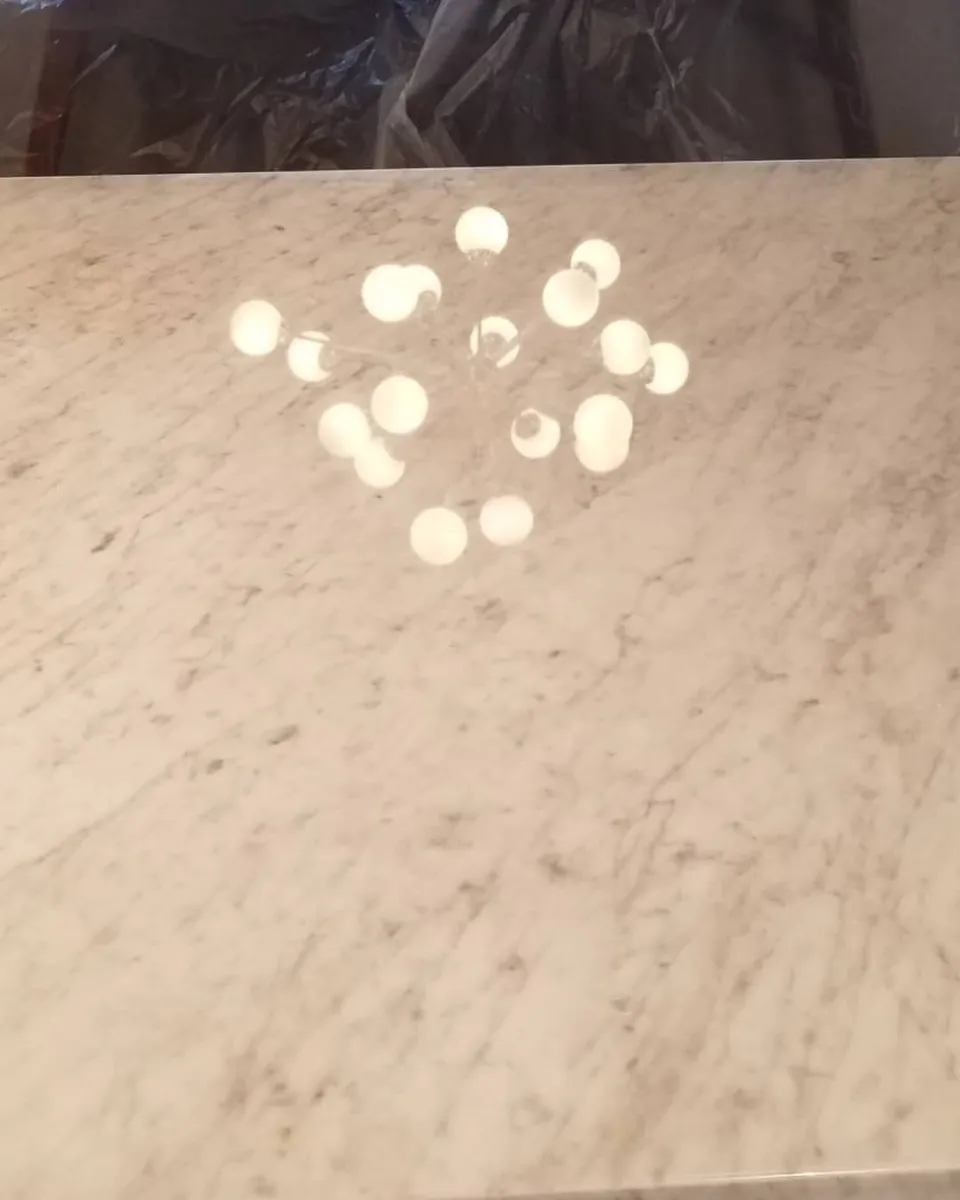
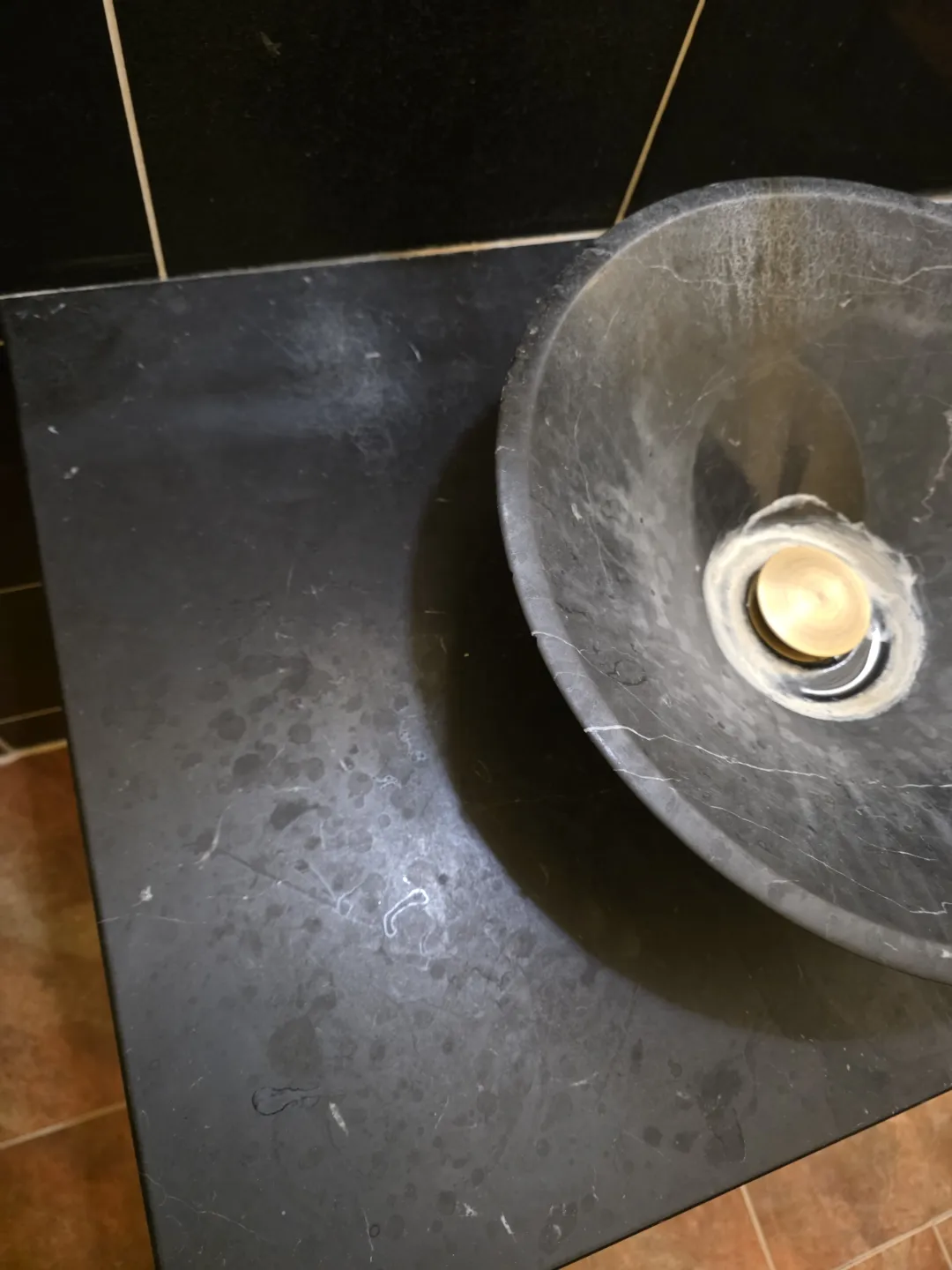
- Etching: surface damage that often looks dull, cloudy, or lighter at a low angle.
If you are trying to identify a dull mark, start with the marble etching guide rather than applying a stronger cleaner.
What types of marble are common in Las Vegas homes?
Homeowners often identify marble by a commercial name, color, or vein pattern. Those clues are useful, but they are not a complete material diagnosis. The Natural Stone Institute explains that commercial stone groups are based partly on performance and appearance, so a stone sold as marble may not match a strict geological definition.
Carrara, Calacatta, and Statuario
Carrara is commonly associated with white-to-gray backgrounds and soft gray veining. Calacatta is often used for lighter stone with stronger movement, while Statuario is another well-known commercial name. Individual slabs vary, and similar names are also used for engineered quartz and other marble-look products.
Crema Marfil, Emperador, and dark marble
Crema Marfil is a familiar beige commercial name. It is also a useful reminder that commercial and geological labels can differ: the Natural Stone Institute notes that some stone sold in the marble group may be scientifically classified as limestone. Emperador, Dark Emperador, Nero Marquina, and other dark names can show haze, fine scratches, and water marks strongly under reflected light.
Do not assume a named marble is universally harder, more porous, or safer than another. Identify the actual material, finish, and condition before choosing a treatment.
Honed vs. polished marble: which finish is easier to live with?
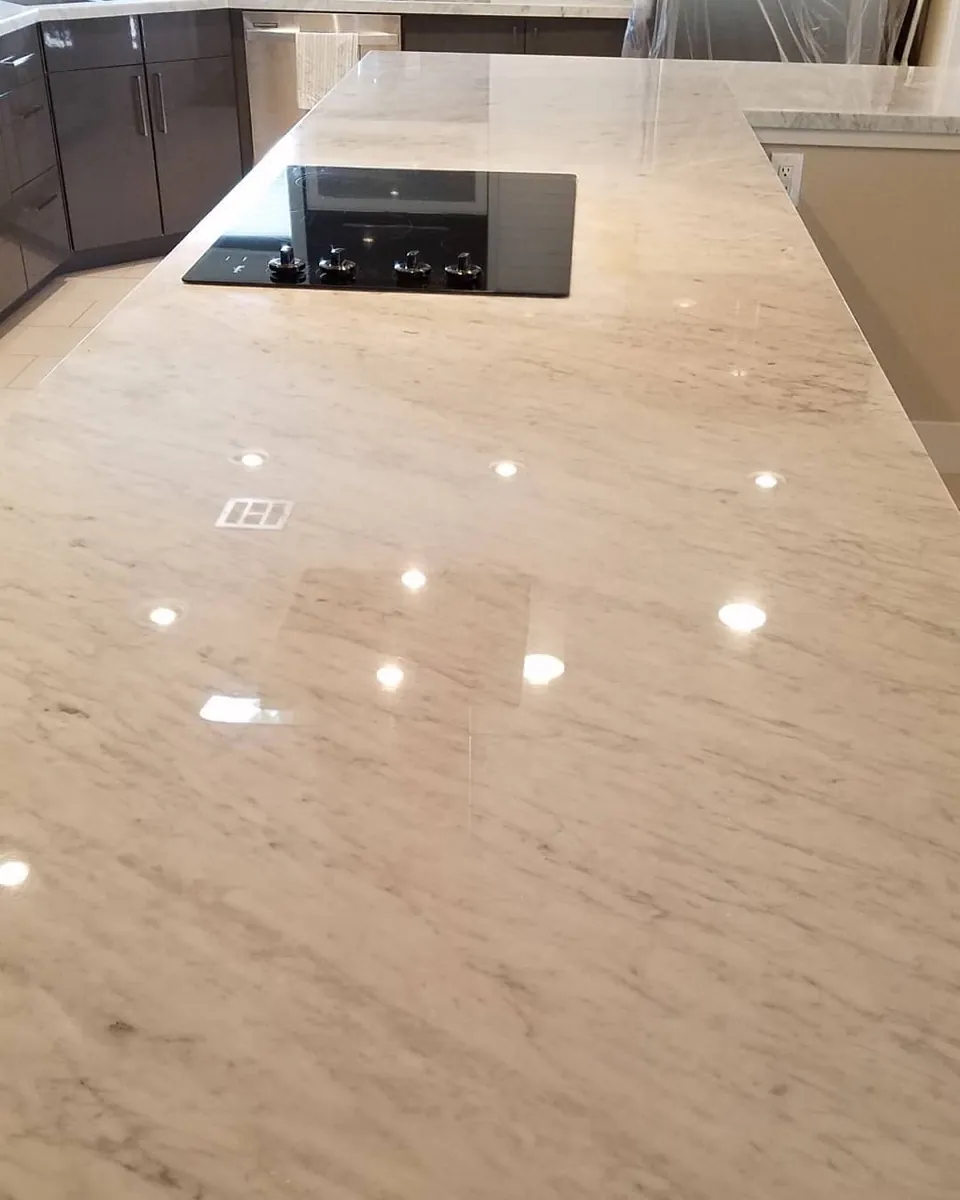
Honed and polished describe the finish, not the type of marble. Polished marble is glossy and highly reflective. Honed marble is smooth with a matte or satin-like appearance.
- Polished: emphasizes color, veining, and reflected light. Etches and fine scratches can stand out under direct light.
- Honed: reflects less light, so small etches often blend into the surrounding surface. It is not acid-proof or damage-proof.
- Both: need neutral cleaning, prompt spill cleanup, and protection from grit and abrasive products.
Read the deeper honed versus polished marble guide before choosing a finish or changing an existing one. If a finish is patchy, the right answer may be re-honing or re-polishing rather than cleaning one spot.
A safe marble-care routine for Las Vegas homes
Countertops and vanities
Use a clean soft cloth or microfiber cloth with a neutral stone cleaner, stone soap, or mild liquid dish detergent diluted according to product directions. More cleaner is not better; excess soap can leave a film. Rinse when the directions call for it, then dry with a soft cloth.
Use coasters under drinks, especially citrus drinks and alcohol. Use a cutting board and a trivet or mat under hot cookware. After a spill, blot instead of wiping it across a larger area. If a dull ring remains after the surface is clean and dry, it may be etching rather than a stain.
Floors
Dust-mop often with a clean, non-treated dry mop. Sand, dirt, and grit are abrasive; mats or rugs at entrances reduce what reaches the floor. Keep the underside of a mat slip-resistant and free of trapped grit. For traffic lanes and scratches, see marble floor polishing in Las Vegas.
Showers
Use a squeegee after each use to reduce water and soap residue. Avoid vinegar, acidic soap-scum removers, scouring powders, and unknown bathroom sprays. Hard-water scale often feels raised or crusty; etching is commonly smooth but dull. For persistent haze or wet-area damage, compare the symptoms with marble shower restoration options.
What Las Vegas hard water and desert conditions change
SNWA’s published water-hardness figure explains why mineral deposits are a recurring local maintenance issue, but it does not mean every white mark is hard-water damage. A deposit may be sitting on the surface, or water exposure may be part of a larger residue or etching problem.
The National Weather Service describes Las Vegas as a desert valley with abundant sunshine, hot summers, low precipitation, and occasional blowing dust and sand. The practical response is simple: control grit at entrances, wipe spills promptly, and dry wet-area surfaces instead of letting residue accumulate. For the larger local picture, read the Las Vegas hard-water and stone-damage guide.
Cleaning, sealing, honing, polishing, and restoration are different jobs
- Cleaning removes dirt, soil, residue, and some surface deposits.
- Sealing or impregnating can increase stain resistance. It does not make stone stain-proof or prevent acid etching. Follow the product and stone supplier’s instructions rather than a universal calendar.
- Honing changes or restores a smooth matte finish and can remove some surface damage.
- Polishing restores a glossy, reflective finish through an abrasive process suited to the material and existing finish.
- Restoration is the broader decision that may include cleaning, stain treatment, scratch or chip repair, honing, polishing, blending, and sealing.
The IICRC’s Stone, Masonry and Ceramic Tile Cleaning Technician certification covers maintenance and cleaning of natural and human-made stone, ceramic tile, masonry, and grout surfaces. That is useful context when choosing a professional, but a credential does not replace identifying the material and documenting the condition.
For an existing dull, etched, scratched, or hazy surface, start with Las Vegas marble polishing and restoration. Henderson homeowners can compare marble polishing in Henderson, while Summerlin homeowners can review marble countertop polishing in Summerlin. The right service may be a maintenance polish, re-honing, deeper restoration, cleaning, or no treatment at all.
When to stop experimenting and request an assessment
- Safe cleaning and drying do not change the dull mark.
- The mark is smooth but cloudy rather than raised and crusty.
- A scratch catches a fingernail or a chip affects an edge.
- The surface finish is patchy after a DIY product.
- You are unsure whether the slab is marble, quartzite, engineered quartz, porcelain, limestone, serpentine, or onyx.
Send a wide photo, a close-up of the worst area, and a photo showing the surrounding finish. Request an assessment or call/text (702) 605-6528.
Tags: